|
Koi Pond
Water Quality
by Elmer Epistola
Posted: October 13, 2004
Koi
enthusiasts never take their pond water for granted. Just
count the number of articles on the web discussing how to keep your
water clean enough for your koi. There are literally hundreds
of them. Now add one more to the list -> this article. I
guess a koi website won't be complete without one.
Water quality,
as said many times before and to which we all agree, is the
most important
factor in the pond that affects
koi health (and happiness). The question, therefore, is not on
the importance of diligently keeping our pond water clean, but on
how well we know if we're meeting the requirements. Unless we
have a way of measuring the cleanliness of our pond water, we can
not really claim that we have good water, regardless of how
frequently the mats are cleaned or how clear the water is.
Water testing kits, which are now widely available in the market,
should therefore be part of any koi hobbyist's toolbox.
Koi experts agree that water is
good enough for your koi if: 1) it is free of chlorine and
other chemicals such as pesticides, heavy metals, organophosphates,
etc.; 2) it has undetectable levels of ammonia and nitrite; 3) its
hardness, pH level, and temperature are correct; 4) it has low
levels of dissolved organic compounds (DOC) and particulate organic
compounds (POC); and 5) it is stable in its quality.
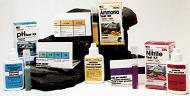
Figure 1. Examples of
water testing kits
for different water quality
parameters
In the place where we live
south of Manila,
chlorine in the water is
not an issue because we get our water from deep wells. If you
get your water from the tap, then chances are that it has been
treated with chlorine. You can actually 'smell' chlorine in
the water, especially if you're like me who uses deep well water.
Chlorine, even at the level present in tap water, is deadly to
koi. Thus, you must never put koi in pond just filled with
chlorinated water. 'Aging' the water by 24 hours prior to
putting your koi in is one advice that you can follow. Later
additions of tap water may be done as long as they're small in
quantity compared to the bulk of your pond water. Testing of
chlorine level after each addition is highly recommended.
Ammonia (NH3)
is the next deadliest contaminant in pond water, next only to
chlorine. One part per million is already detrimental to the
fish. The main source of ammonia, unfortunately, can not
be removed from the pond. This is because ammonia in the pond
comes primarily from the koi themselves. Ammonia will
therefore always be present in the pond as long as there are koi (or
other fishes and animals) living in it. The good news is that
ammonia is easily converted to less harmful compounds by certain
types of bacteria (nitrosomonas) through biological filtration.
The threat of ammonia
contamination poses the highest risk while the pond is still new.
This is because new ponds still lack the colony of 'good' bacteria
needed to convert ammonia into less harmful compounds. Koi
experts recommend daily checking of ammonia levels and daily 50%
water changes in new ponds until ammonia readings stabilize.
The threat of ammonia in new ponds is so serious that there's even a
name for this phenomenon - the
'New Pond Syndrome',
or NPS.
I myself had been a victim of
NPS when I was starting out. At that time, I was mainly
concerned with the adequacy of oxygen supply in the pond. I
just switched from aquarium keeping to pond keeping, and never even
had the inkling that ponds are also filtered. I enjoyed
adding fish to the pond during the first week, only to be greeted by
a couple of dead fish one morning during the following week.
The next few days that followed were horrific - fish died daily
until I practically had nothing left. In panic, I bought books
about setting up ponds and immediately saw where I could have done
things differently. Novice hobbyists who are about to set up a
new pond must not take this phenomenon for granted.
At low levels (below 0.1
mg/liter), ammonia acts as a strong
irritant
to the koi, especially to its
gills. Flashing may be exhibited by koi irritated by low
levels of ammonia. Higher ammonia levels can lead to skin and gill
hyperplasia. Gill
hyperplasia refers to
the condition wherein the secondary gill lamellae become swollen,
resulting in breathing problems for the koi. Serious gill
disease and death can occur if the lethal levels of ammonia
contamination are reached.
The acceptable
ammonia reading
for koi ponds is, well,
zero.
Thus, your pond is threatened by ammonia as long as your test kits
are able to detect ammonia in your water.
Sooner or later, the rate of
ammonia level build-up in a new pond will decrease as biological
filtration does its job, but another toxic compound will be taking
over as this happens. Ammonia is converted by the nitrosomonas
bacteria into nitrites, which are also harmful to the fish, but not
as deadly as ammonia. Nitrite levels therefore shoot up as the
ammonia levels go down in a new pond.
Nitrites (NO2)
at low levels can subject the koi to stress, making it vulnerable to
diseases caused by other factors. High levels of nitrites
cause skin and gill epithelia damage, which can lead to parasitic
invasion or secondary bacterial infections. Fish suffering
from nitrite poisoning will be gasping at water surface and stay
around water outlets. Water testing kits must register
nitrite readings
of zero
as well if the water is to be considered nitrite-safe. Unsafe
nitrite readings can be corrected by sufficient partial water
change. Adding salt to the pond (around 0.02%) also makes nitrites
less toxic to koi, since their gills will tend to take up the added
chloride ions instead of the nitrite ions, getting protection from
the latter.
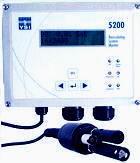
Figure 2. An electronic
device capable of
testing several water
parameters
Eventually nitrite readings in
a new pond will go down, just like the reduction of ammonia levels
before it. Again, the reason for this is the conversion of
nitrites into nitrates by 'good' bacteria, this time the nitrobacter
sp. Nitrates are significantly less toxic than nitrites, but
they should still be included in regular water quality checks.
Nitrates (NO3-)
are generally harmless to koi, although koi had been observed to
lose their appetite if the nitrate level is allowed to go unchecked.
Nitrate level should always be kept under
60 parts per million (ppm),
which is equivalent to 60 mg per liter, although some koi experts
say that a nitrate level of 100-500 ppm is not yet detrimental to
koi. Partial water change is a good remedy to
higher-than-normal nitrate level. The use of plants and
trickle filters will go a long way in stabilizing the nitrate level
of the pond.
A
weekly
test for ammonia and nitrate levels is recommended, although this
frequency may be diminished if the pond has matured enough and
stable readings are already being taken consistently. Nitrate
level testing can be done only once a month. Of course,
any change
in the filtration system or koi pond itself necessitates a more
frequent regular monitoring once more until the readings stabilize
again.
Copper
and
iron
are examples of metals that are toxic to koi. Be sure that
your pond water is not exposed to these metals. Possible
sources of copper and iron are your piping system, heaters, and even
your filters.
Koi pond
water pH
is another water quality parameter that needs to be checked
regularly. The term 'pH' stands for 'pondus hydrogenii', and
is a measure for how acidic or basic your pond water is. A pH
of 7 means that the water is neutral. As the water becomes
more acidic, the pH number goes down. The pH number goes up as
the water becomes more basic. Koi pond water pH must be
maintained between 7
and 8.5.
Off-scale pH readings can
result in direct physical damage to the skin, gills, and eyes of the
koi. Prolonged exposure to incorrect pH can lead to stress and in
extreme cases, epithelial hyperplasia (swelling of the gills) or
even death.
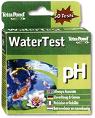
Figure 3. An
off-the-shelf pH Test Kit
Water hardness,
on the other hand, measures the mineral (calcium, magnesium, iron,
zinc, etc.) content of the water.
These minerals are usually brought into the pond by rainwater that
has percolated through rocks. There are two hardness numbers
usually monitored in koi ponds, i.e., the KH (for carbonate
hardness) and the GH (for general hardness).
The pond's KH level (also known
as the alkalinity) determines its pH buffering capability, or the
ability of a pond to keep itself from becoming too acidic. The
pH of a pond is affected by a lot of things (such as plant
photosynthesis and the production of acids during nitrification),
and can swing in value from time to time. One way to stabilize
the pH of a pond is by neutralizing any acids introduced into the
pond with carbonate and bicarbonate ions, a process known as
buffering.
GH is just the sum of KH and
another hardness parameter, the permanent hardness. In a koi
pond, the permanent hardness is negligible compared to the KH, so GH
and KH may be treated as one for practical purposes.
In most water systems, water
hardness (GH or KH) is quantified in terms of the amount of calcium carbonate
(CaCO3) in the water (mg per
liter or ppm). Very hard water contains greater than 300 mg of
calcium carbonate per liter of water while soft water contains less
than 75 mg per liter. Koi ponds, according to koi experts, should have a water hardness
of 100-150 mg CaCO3 per liter of
water, or 100-150 ppm.
Soft pond water should be avoided because it forces the
koi to exert more effort in osmoregulation, the process of
maintaining internal body water concentration to the correct level.
Furthermore, a low KH results in pH instability, which can be lethal
in extreme cases of pH swing. On the other hand, mineral deposits will form in the pond if the
hardness exceeds 150 ppm. Note that some koi experts advise higher
hardness levels than this (even up to 300 mg), if only to assist the
fish in osmoregulation.
Water to us is but something to
drink, take a bath with, or swim in. To our koi, however, it
is what they breathe and live in, what dictates their bodily
functions and, ultimately, what determines whether they will live or
die. Indeed, koi pond water quality is something that every
koi enthusiast must never take for granted.
See also:
KOI CARE;
KOI POND FILTRATION BASICS
References:
1)
www.fishdoc.co.uk; 2)
http://www.geocities.com/koifla/New_Pond.htm;
3)
Water Testing and Test Kits
by Dick Roemer;
4) Koi World 2003-2004
Annual
HOME
|



